Medical Rehabilitation Research Resource Centers
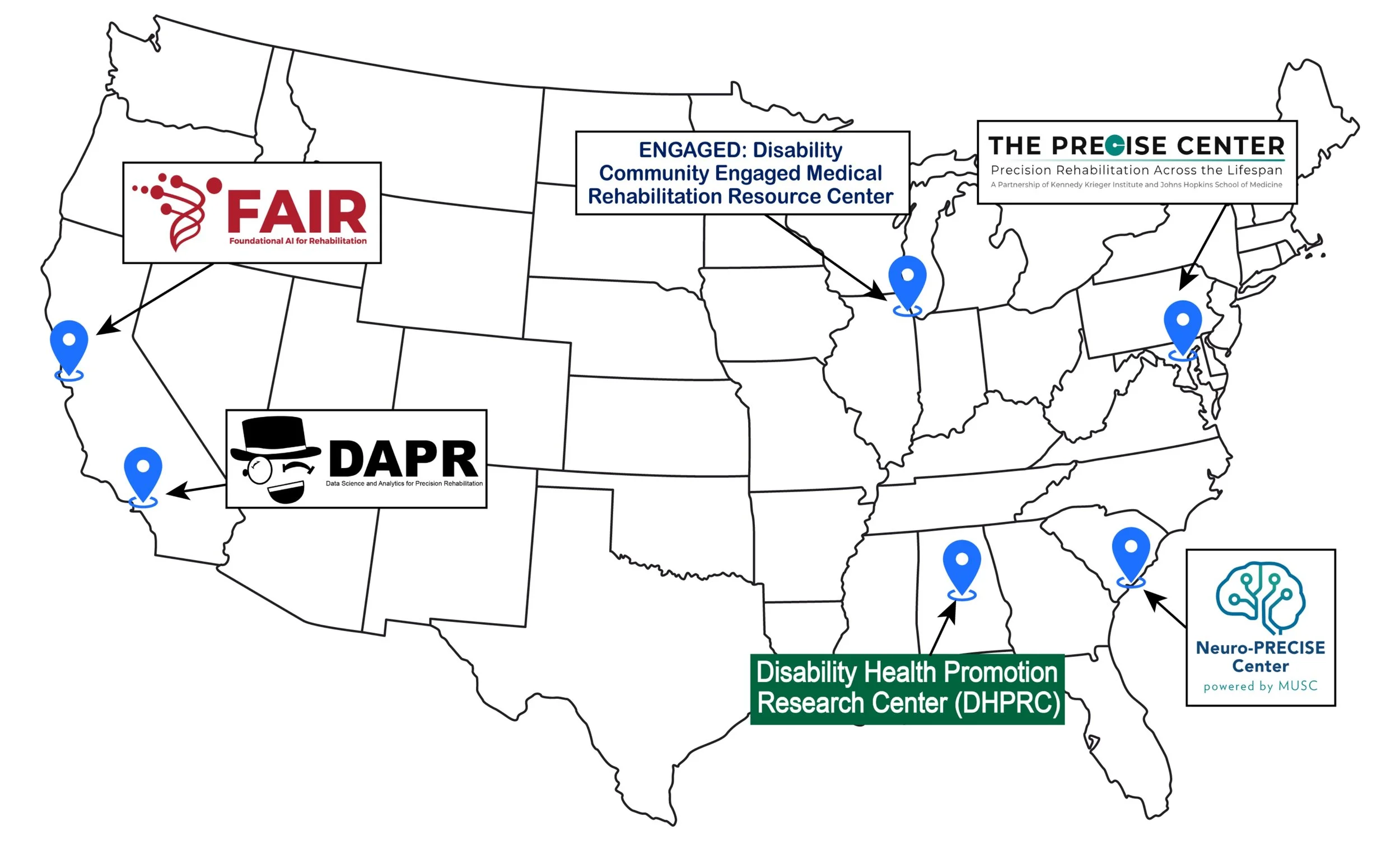
Five NIH Institutes (NCMRR/NICHD, NINDS, NIBIB, NIDCD, and NCCIH) have funded six P50 centers collectively tasked with developing and disseminating techniques, data, theories, research programs, and expertise with the goal of enhancing the capability of medical rehabilitation investigators. These six centers seek to understand mechanisms of functional recovery, develop therapeutic strategies, identify clinical care gaps, and improve the lives of people with disabilities.
About Our Centers
DAPR aims to generate large, harmonized rehabilitation datasets for personalized, precision rehabilitation and improve the rigor of medical rehabilitation research by leveraging data science, artificial intelligence (AI), and machine learning (ML).
Supported by NIH P50HD118603.







Our mission is to enhance health outcomes and quality of life for people with disabilities through innovative research focused on health promotion and prevention of secondary conditions. Through transdisciplinary collaboration, community partnerships, and inclusive research practices, DHPRC addresses health disparities and advances equitable health solutions—particularly for underserved populations in the Deep South. DHPRC integrates cutting-edge science, lived experience, and community engagement to produce real-world impact.
Supported by NIH 50HD118626.

The ENGAGED Center is a bi-institutional collaboration between the University of Illinois Chicago and the University of Texas Health Houston/TIRR Memorial Hermann that aims to build research that brings together people with disabilities and rehabilitation researchers to address social factors that influence health and participation outcomes among people with disabilities.
Supported by NIH P50HD118631.
The FAIR Center at Stanford University is creating a worldwide collaboration to unlock the potential of AI models and data to improve rehabilitation outcomes. Central to this mission, the Center is developing and validating a Foundational AI for Rehabilitation (FAIR) Model to address a range of movement-related tasks.
Supported by NIH P50HD118632.
An NIH-funded resource center focused on developing knowledge and diagnostic tools and methods to precisely characterize, modulate, and rehabilitate neural circuits underlying function and recovery.
Supported by NIH P50HD118628.
The Precise Center at the Kennedy Krieger Institute and Johns Hopkins University School of Medicine will provide a blueprint and necessary tools to help clinicians and researchers working across the lifespan move from a one-size-fits-all model of care toward a model of precision rehabilitation.
Supported by NIH P50HD118624.